Kayapó set to fight massive dam project
April 27, 2006
This page was created in 2006 and may contain language which is now outdated.
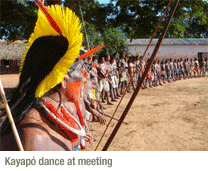 Mebegokre Kayapó Indians have vowed to oppose the building of five dams along the Xingu River in Amazonia. Two hundred Kayapó met recently to discuss the dams, which they fear will have a devastating impact on the environment and will flood large parts of their land.
Many Kayapó expressed their concern and anger that the Brazilian government and the electricity company Eletronorte had not been open about the project, and had flouted Brazil's constitution by failing to consult with the communities who will be affected if the project goes ahead.
In 1989 the Kayapó organised a huge meeting in Altamira to protest against a similar dam building project. They successfully stopped the dams from going ahead by catching the attention of the world's media and obtaining widespread international support.
Faced with a similar scenario, the Kayapó are now building local and regional alliances. The organiser of the meeting, Megaron Txukarramãe, said, We call on all the inhabitants of the Xingu Valley to join with us in a great demonstration in Altamira against the Belo Monte dam and the other dams that Eletronorte wants to build throughout our valley, and for the protection and development of our own productive powers, our cultures and communities.'
Below is a report on the meeting.
DECLARATION OF THE MEETING OF THE MEBEGOKRE KAYAPÓ AT PIARAÇU, MATO GROSSO, MARCH 28APRIL 1, 2006
 200 representatives of 19 of the 21 communities of the Mebegokre (Kayapó) people met for five days in the village of Piaraçu between the 28 of March and the 1 of April. The main subject of discussion was the project of the Brazilian government to build the Belo Monte dam and four other hydroelectric dams on the Xingu River and its main tributary, the Irirí.
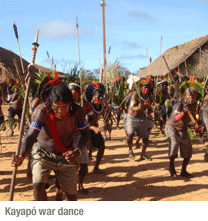
The participants in the meeting were unanimously opposed to the construction of these dams, alleging that they would have catastrophic effects on the ecosystem, and would flood large areas of Indigenous territory. Many speakers introduced their remarks by singing their personal war-songs, and warned that if the government proceeds with the construction of Belo Monte it would bring on war with the Kayapó. They also denounced the failure of Eletronorte and President Lula da Silva to disclose the true extent of the plan, noting that they regularly present it in public as a scheme involving only the single dam of Belo Monte, whereas the project as a whole actually includes five huge dams.
One point repeatedly emphasized by speakers was that Eletronorte and President Lula, by not coming to Kayapó communities and those of other regional people to explain openly the details of their plans, or allowing for the Kayapó to discuss the project in the National Congress, are in violation of national law, which requires that any development project which involves potentially damaging effects on Indigenous territories should be discussed with the Indigenous communities likely to be affected, and those communities should have the opportunity to discuss the project in the National Congress.
 In addition to their intransigent opposition to the dams, the representatives of communities situated on the banks of the Xingú denounced the increasing pollution of the river resulting from agricultural activities, such as the massive cultivation of soy beans, and cattle ranching, in close proximity to the tributaries of the river. They demanded that the state regulate these activities to prevent the destruction of the riverine ecosystem.
A second major theme of discussion was the insecurity of the boundaries of those territories that have already been legally recognized by the state as Kayapó reserves. Invasions of Kayapó areas are currently running at an all-time high, and FUNAI, according to the testimonies of many speakers, is not dealing effectively with the crisis.
While demanding a more a more adequate response by the responsible organs of government, such as FUNAI, the Ministério Público (Attorney General's Office), and the Federal and State police, the representatives reported on measures that they themselves are taking to deal with the problem. The most important of these is the establishment of guard posts along the frontiers of the several Kayapó reserves. Each community has taken responsibility for the section of the border which passes along its area of the reserve. To fulfill this responsibility the communities found guard posts at strategic points along their boundaries, assigning community members to stay at the posts, patrolling and standing guard. According to the speakers at the meeting there are now more than sixty such posts, each with a man designated as in command.
The third main theme of the meeting was the promotion of projects for the communal production of forest products. These projects attempt to substitute sustainable productive activities for unsustainable extractive activities such as logging and gold mining as sources of community income. They are motivated in part by awareness of the importance of protecting the natural environment by using sustainable forms of production, and in part by a realization of the urgency of developing foci of occupation and utilization of forest resources along the frontiers threatened by invaders.
The new guard posts thus fulfill a double role as centers of exploitation of forest resources, such as Brazil nuts (both in unprocessed form and in the form of oil pressed by machines that have now been installed in four villages), cupuaçú, copaíba, tree resin, bacaba, cacao, genipapo, jaborandí, and honey (this last supported by an excellent project of FUNAI). Several villages are also producing normal agricultural crops, such as rice, beans, manioc, and banana for regional markets. These activities have contributed to a general turning against the contracts with Brazilian extractivists (miners and loggers) that played a dominant role in the Kayapó economy in the 1980s and early 1990s by virtually all Kayapó communities (there are still a handful of minor exceptions involving sub-groups in a few communities).
In the words of the organizer of the meeting, Megaron Txukarramãe, We Mebegokre Kayapó are aware that the problems that threaten the lives of our communities in the Xingú Valley also threaten other peoples, both Indigenous and Brazilian, who also live in the valley. The solution of these problems, and thus the effective protection of our river and our forest, forms part of a common struggle, which we share with all the peoples of the Xingú Valley.
'Eighteen months ago, we met together with the other Indigenous peoples of the Upper, Middle and Lower Xingú in Piaraçu to forge a common front against these threats. Now, following upon the successful conclusion of the meeting of all of our own communities, we are entering upon the next stage of our struggle, contacting organizations of national Brazilian settlers of the Lower Xingú and the Transamazonica to form an alliance of all the peoples of the Valley of the Xingú to save our river from the dams, from pollution, and all kinds of destructive development, and to promote alternative forms of production based on the productive powers of local communities using sustainable resources.
'We call on all the inhabitants of the Xingú Valley to join with us in a great demonstration in Altamira against the Belo Monte dam and the other dams that Eletronorte wants to build throughout our valley, and for the protection and development of our own productive powers, our cultures and communities.'
Colider, Mato Grosso, Brazil April 04, 2006
The costs of transportation and lodging for the meeting were born by Conservation International, the Wild Foundation, the Moore Foundation and the Brazilian National Foundation for the Indian (FUNAI).
Text prepared by Terence Turner, Megaron Txukarramãe, and Luis Carlos
Sampaio. Translation of original Portuguese, Declaração da Reunião do
Povo Mebengokre Kayapó, Piaraçu, MT, 28 Março a 01 Abril de 2006', by
Terence Turner.