Mursi eviction fears grow
June 19, 2006
This page was created in 2006 and may contain language which is now outdated.
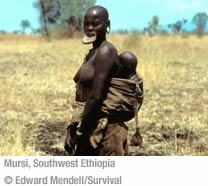
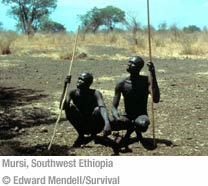
The Mursi, a nomadic, cattle-herding people living in the Omo National Park in southwest Ethiopia, fear eviction from their ancestral lands in the name of conservation. If evicted, they will lose precious agricultural and grazing lands which are central to their livelihood and identity.
 In September 2005, the African Parks Foundation (APF), a private non-profit organization based in the Netherlands, signed an agreement with the Ethiopian government to manage the Omo National Park which is home to the Mursi people. However, it has consistently refused to recognise and guarantee the land rights of the Mursi, claiming that it could not interfere' in the policies of a sovereign government'.
According to the anthropologist David Turton, who has worked with the Mursi for over 30 years, the Mursi and their neighbours in the Omo Valley have suffered for years from the creation of state farms, national parks and the allocation of hunting concessions to safari companies on and around their land. Their children have become steadily more vulnerable to malnutrition, death and disease as vital resources are taken over by outsiders.
 In December 2005, the APF said that it would not be possible to guarantee the Mursi's land rights because the government would not agree to this, and in any case it would not be necessary because the rights of pastoralists' to their land are already guaranteed by the Ethiopian constitution (Article 40, 5). In practice, however, these constitutional rights are rarely if ever upheld. APF then stated in a letter that we are not going to make written agreements with the local people'. According to Dr Turton, APF may protest as much as it likes, therefore, that it has no intention of displacing people from their land, but unless it is prepared to enter into legally binding agreements to back up its claims, it cannot expect them to be taken seriously.'
APF has also failed to make available to the Mursi the contracts it has signed with the federal and regional governments, thereby denying them the right to seek and obtain independent legal advice about a contract that will have enormous consequences for their own and their children's futures, and which was agreed and signed without their knowledge or consent.
 When the park's boundaries were mapped out, the Mursi were not given copies of documents the government asked them to sign, using their thumb prints, in which they agreed' to the current park boundaries. This process of demarcating the park boundaries made a mockery of prior informed consent', contravened international agreements on the rights of Indigenous people, and revealed a colonialist attitude on the part of the Ethiopian government towards its own citizens to which APF has turned a blind eye.
APF's standard response is that all these matters so crucial to the Mursi will be negotiated and agreed upon in the course of discussions and consultations with local people over the coming months, leading up to the writing of a management plan' for the park. But as Dr Turton has said, 'What kind of negotiation' is it in which one side has all the financial and political power and the other has no legally enforceable rights at all? To speak of negotiation' in these circumstances is utterly meaningless. The, Trust us: everything will be sorted out in the management plan', approach looks, in practice, like a way of ensuring that all decision-making power remains firmly in the hands of APF. It is unlikely that local people would be happy with this approach in any case.'
Mursi supporters are lobbying APF to:
sign legally binding agreements with each of the groups living in the park and/or making use of agricultural or grazing land within it, guaranteeing their right to a secure livelihood in their existing territories;
specify, in writing, the social and economic benefits that are expected to accrue to local communities, including an agreed percentage of tourist and hunting revenues;
make freely available to local people the full text of any agreements it has signed with the federal and regional governments; and
provide local people with copies of the documents they were asked to sign during the boundary demarcation process, and by which their prior informed consent' was obtained to the legalisation of the park boundaries.
By taking these steps APF would be helping to empower the groups living in and around the Omo National Park, so that they could genuinely negotiate, and take part in shared decision making, about park management. By empowering local people, APF would inevitably be ceding some of its own power – a difficult thing to do. But if it really believes that the strong support of the Mursi and other local people is fundamental to effective management of the area', there can be no other way.